Workflows
Turn saved meeting transcripts into repeatable analysis, local action items, reviewed service drafts and scheduled reports.
Start with a template or a blank workflow
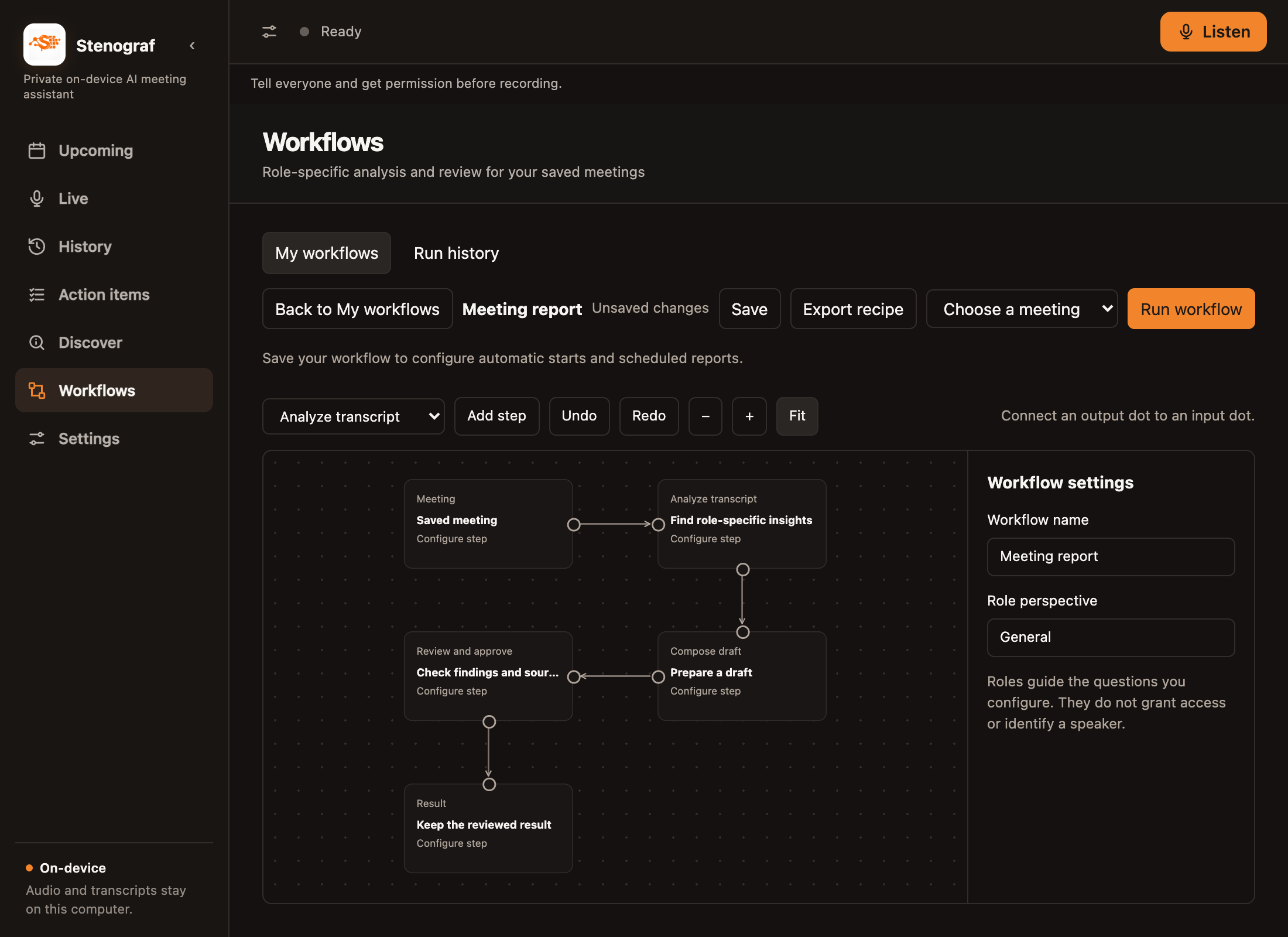
Open Workflows → My workflows → New workflow. Choose a role template or a blank start. Give the workflow a name, edit its analysis question and connect the steps. Templates are editable starting points; there is no public role marketplace in the current app.
For a product meeting, try Share decisions in Slack. Ask for decisions, owners and unresolved questions, keep the source passages, and prepare a Slack draft for review. You can also save a decision, task or note locally without a service connection.
Available steps
- Saved meeting supplies the transcript for the run.
- Analyze transcript asks a question using meeting evidence.
- Branch follows its true or false path according to whether the earlier output contains the configured text.
- Compose draft prepares text from earlier results.
- Review and approve pauses for a person to check the result.
- Create action item saves a local decision, task or note.
- Action service prepares an operation from the services listed in Settings.
- Result keeps the workflow output locally.
Run it on one meeting
Save the workflow, choose a completed meeting and run it. Use the run view to inspect step status, output and failures. A failed analysis must be resolved before relying on its downstream draft. The local language model must be ready for analysis; see local model setup.
Choose when it starts
Open Automatic start and reports for the workflow. Choose Run manually, An intent is detected, A meeting is completed or On a schedule. For an intent trigger, describe the request or event you want to detect—for example, “a customer requests a refund; ignore hypothetical examples.”
Use a meeting label and title filter to narrow automatic runs. Leave the filters empty to apply the rule across eligible meetings. Choose Run automatically and Save automatic start to enable it. Saving publishes the saved recipe for future runs; it does not send a service action.
Prepare recurring reports
Schedules offer hourly, daily and weekly intervals and a next-report time. Choose New meetings only or All matching meetings. New-meeting reports cover matching meetings after the rule is enabled; adding a label later does not reprocess an older meeting in that mode.
All-matching reports process the matching meetings again each period, in reports of up to 50 meetings. Schedules run while Stenograf is open and catch up when reopened. They are not a cloud scheduler.
Review the output in Action items
Action items brings together workflow reviews, reports and service drafts with their transcript passages. Open the source before approving. A service step needs a separate destination and content review followed by Confirm and send or Confirm and create. See Action services and integrations.
Sent items retain their service outcome and any returned link. They no longer count as waiting for review. If the send outcome is uncertain, check the destination before attempting another send.