
Recording
What Stenograf hears, how it tells voices apart, and how to record a meeting you missed.
Your microphone
Computer audio is taken from the apps that are playing, so there is nothing to choose for it. Choose the microphone in Settings → Recording → Microphone. The choice applies to the next recording. If the microphone you chose is unplugged, Stenograf stops and says so rather than quietly recording another one.
Turn on Headphones mode when your speakers cannot reach your microphone. It switches off echo cancellation, which is only needed when the call plays out loud.
Speakers and names
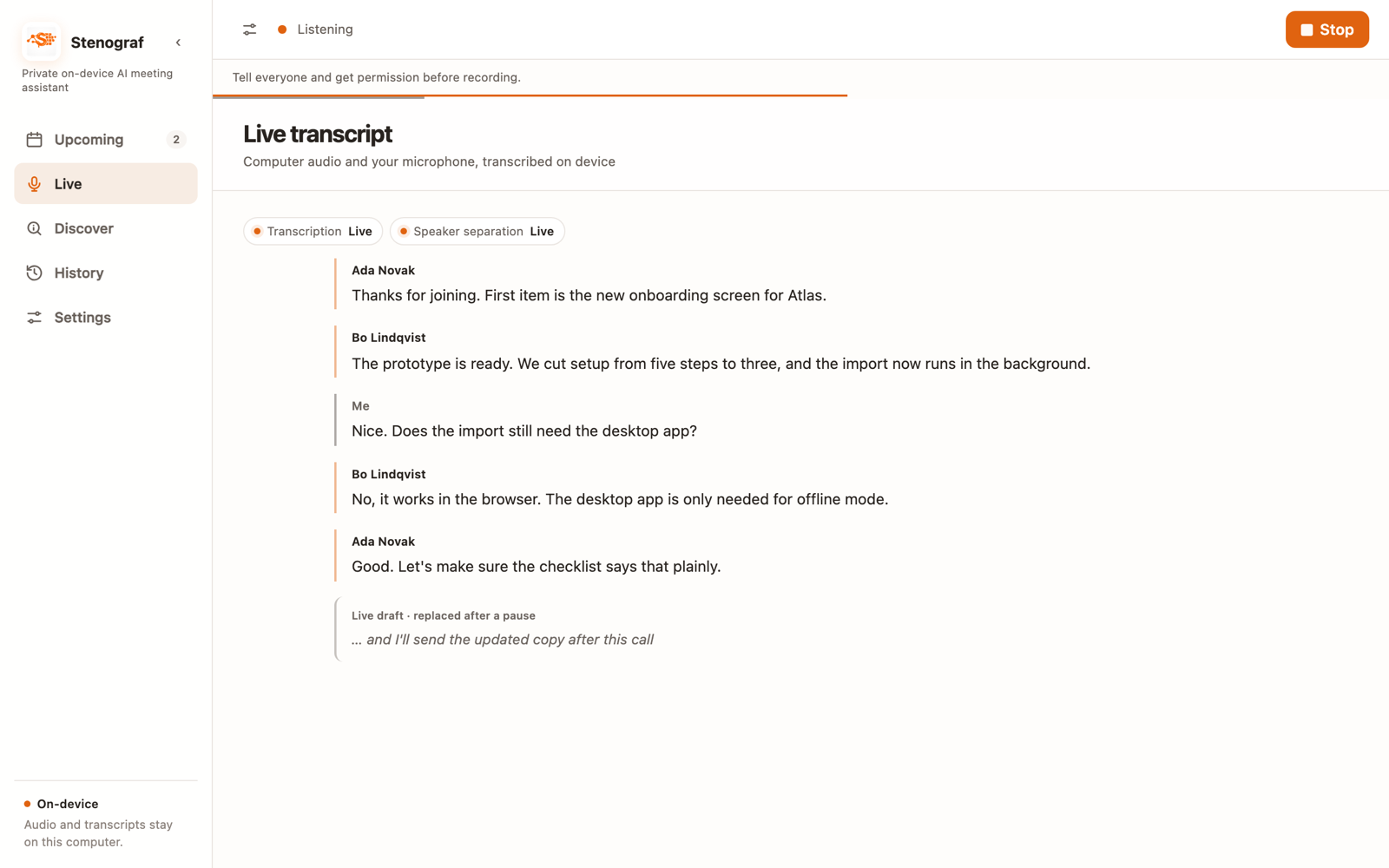
Your microphone is always Me. Other voices get numbers until you name them: choose Name speaker in Live, and Stenograf saves that voice on this computer and recognises it in later recordings. Renaming a speaker in History changes only that recording.
When Stenograf is not sure whose voice a line is, it leaves the line unlabelled rather than guess. A missing name is deliberate; a wrong one would be worse.
Meeting reminders
Connect Google Calendar, Outlook Calendar or, on a Mac, the Calendar app in Settings → Calendars, and Stenograf reminds you as an online meeting starts, with Join & Listen to open it and start recording in one click. Nothing starts without that click. The recording keeps the meeting’s title and attendees, which later helps Discover find it. The Calendars guide has the rest.
Import a recording
Missed recording a meeting? In History, choose Import audio and pick the file. It goes through the same transcription and speaker recognition as a live recording and is dated by the file. Importing audio is on macOS for now.
Bring your meetings from Otter, Granola, Fireflies or Zoom
A transcript another tool wrote can become a saved recording too. In History, choose Import transcript, say which app it came from, and pick the file — Otter’s TXT or SRT export, Fireflies’ JSON, TXT or SRT download, a Zoom cloud recording’s VTT transcript, or notes saved as Markdown or text — or paste the text, with a name and the meeting’s date, which is how a Granola transcript comes across. History says where each recording came from, and Discover searches it like any other. Speaker names stay exactly as written; they never become voice profiles, because no audio was heard. The same export is never imported twice. This works on Windows as well as macOS; the moving guide has each tool’s steps.
Recording responsibly
By default Stenograf keeps no audio: it transcribes in memory and saves only the text. Save troubleshooting audio, under Settings → Recording → Recording privacy, keeps local audio files for 24 hours when you need them to report a problem.